The problem usually starts the same way: the doorbell rings, your dog launches forward, and the whole house feels chaotic for the next two minutes. For many owners, figuring out how to train door manners is less about teaching one command and more about creating calm at one of the most exciting moments in the day.
Door manners matter because doors trigger everything dogs care about – guests, walks, smells, movement, and novelty. If your dog has learned that rushing the door works, that habit gets stronger every time it happens. The good news is that this behavior is very trainable when you break it into small, repeatable pieces.
Why dogs struggle at doors
Most dogs are not being stubborn at the door. They are reacting to excitement, anticipation, or uncertainty. A puppy may rush forward because every visitor feels thrilling. An adult dog may bark and crowd the entrance because they believe they need to manage who comes in. Some dogs simply have no clear rules, so they make their own.
That is why door training works best when you focus on impulse control and predictable routines rather than constant correction. If your dog only hears “no” once they are already flying at the door, you are trying to stop momentum after it has started. It is much easier to teach what you do want before the excitement hits.
What good door manners actually look like
Before you start training, define the behavior clearly. Good door manners do not always mean the same thing for every household. In one home, success might mean the dog goes to a mat when the bell rings. In another, it might mean the dog sits a few feet back and waits to be released. For a family with young kids, the goal may simply be that the dog does not bolt, bark excessively, or jump on guests.
The key is consistency. If one day your dog is allowed to crowd the doorway and the next day they are scolded for it, progress will be slow. Pick one routine and stick with it.
How to train door manners step by step
Start when nothing exciting is happening. Do not begin with a real guest at the door. Practice at a quiet time of day with treats your dog cares about and enough space to keep them successful.
Step 1: Teach a station away from the door
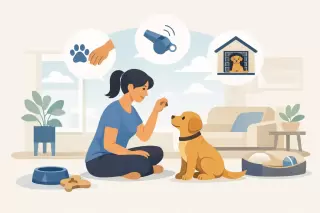
A bed, mat, or clearly defined spot works well. Lead your dog to that place, reward them for standing or sitting there, and repeat until they begin moving to it with less help. You are building a default behavior that can replace door rushing.
If your dog already knows sit or place, that helps, but do not assume they can do it around door excitement right away. Door practice needs its own repetition.
Step 2: Add a stay for a few seconds
Once your dog can get to their spot, reward calm pauses. Start short – one or two seconds is fine. Then build duration slowly. If they pop up quickly, that is useful information. It means the training got too hard too fast.
This is where many owners rush. A dog that can stay on a mat for 30 seconds in a quiet kitchen may still break instantly when the front door handle moves. Train the easy version first, then raise the challenge.
Step 3: Introduce small door cues
Touch the doorknob. Reward. Open the door an inch. Reward. Take one step toward the door. Reward. Ring the bell from your phone or have someone knock lightly. Reward.
You are teaching your dog that door-related triggers no longer mean “charge forward.” They mean “stay calm and listen.” If your dog breaks position, do not punish or lecture. Reset and make the exercise easier.
Step 4: Practice with a helper
Once your dog can stay calm for mild door activity, involve someone they know. Ask your helper to knock or ring the bell, then wait outside while you guide your dog to their station and reward calm behavior. Only open the door when your dog is under control.
If opening the door causes your dog to rush, close it again. That timing matters. The door opening becomes part of the reward for calm behavior, not a bonus your dog gets for being wild.
Step 5: Add the guest entry
Have your helper come in only when your dog is calm. At first, the guest should be boring. No excited greetings, no eye contact, no petting at the doorway. If guests immediately hype up the dog, training gets much harder.
Once your dog can hold position while someone enters, you can release them for a polite greeting if that is your goal. If your dog tends to jump, keep the leash on during practice and interrupt the approach before the jump happens.
The most common mistakes owners make
One common mistake is only practicing when someone actually arrives. Real-life moments are the hardest version of the exercise, and they come with more excitement and less control. Training needs calmer practice sessions first.
Another mistake is repeating cues too many times. Saying “sit, sit, sit, sit” teaches your dog that the first few cues do not matter. Say it once, help your dog if needed, and reward when they get it right.
Inconsistency also gets in the way. If your dog is allowed to blast through the front door for walks but is expected to wait politely for guests, you are teaching two very different rules at the same location. Some dogs can learn that difference, but many need a simpler picture at first.
How to train door manners for different dogs
Puppies usually improve quickly because they have fewer deeply rooted habits, but they also have short attention spans. Keep sessions brief and upbeat. Focus on preventing rehearsals of bad behavior by using a leash, baby gate, or distance from the door.
Adolescent dogs often know the basics but fall apart when excitement hits. With these dogs, patience matters. They are not necessarily ignoring you on purpose. Their impulse control is still developing, so repetition in real home settings makes a big difference.
Rescue dogs or reactive dogs may need a slower approach. If your dog barks, spins, lunges, or becomes overwhelmed as soon as someone appears, the goal may start with distance and emotional regulation rather than a perfect sit-stay. In those cases, progress can look like quieter behavior, faster recovery, and less intensity over time.
When management is just as important as training
Training builds skill, but management prevents setbacks. If your dog has a long history of door chaos, use tools that help you stop the rehearsal of that behavior while they are learning. A leash indoors, a gate between the dog and the entry, or having deliveries left outside can make practice much more successful.
That is not cheating. It is smart training. Every time your dog gets to rush, jump, or bolt through the doorway, the habit is reinforced. Management gives your new routine a chance to stick.
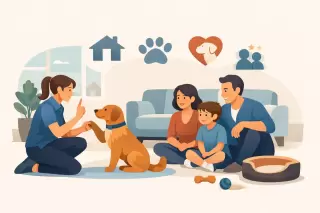
This is also why in-home training can be especially helpful for door issues. The layout of the house, the distance from the front door, the presence of kids, and even where the dog can see windows all affect behavior. What works in one home may need to be adjusted in another.
How long does it take?
It depends on the dog, the consistency of the routine, and how long the behavior has been happening. Some dogs show noticeable improvement in a week or two of daily practice. Others need longer, especially if they are highly excitable or have practiced poor door habits for months.
The biggest shift usually happens when owners stop waiting for the problem moment and start rehearsing the right behavior on purpose. Short sessions done regularly tend to work better than one long session followed by several chaotic days.
What success should feel like
A well-trained dog at the door does not have to look robotic. The goal is not to remove your dog’s personality. The goal is to create a predictable, calmer response so you can answer the door without bracing for impact.
For some dogs, success is quietly holding a place command until released. For others, it is waiting without barking, keeping four paws on the floor, and greeting guests without crashing into them. Real progress is about safety, calm, and control – not perfection.
If your dog struggles despite your best efforts, getting one-on-one help can speed things up because the problem is happening in a real environment with real triggers. That is often where the missing piece becomes clear.
When door manners improve, daily life gets easier fast. Guests come in with less chaos, walks start more calmly, and your dog learns that patience works better than pushing ahead. That is a small change at the doorway, but it often carries into the rest of the house.