A dog who listens beautifully at a trainer’s facility but ignores you at the front door can leave you feeling like you paid for progress you never really got to keep. That is why the question of in home training versus board and train matters so much. The right choice is not just about where training happens. It is about how your dog learns, how your family participates, and whether the results actually hold up in daily life.
For many owners, the biggest behavior problems are not happening in a controlled kennel setting. They happen when guests come over, when the leash goes on, when food is left on the counter, or when your dog hears you call and decides something else is more interesting. Those moments are personal, frustrating, and very specific to your household. That is exactly why the training format matters.
In home training versus board and train: what is the difference?
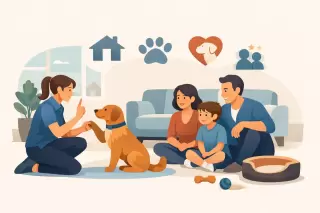
In-home training brings the trainer to you. Lessons happen in your house, your yard, your neighborhood, and around the routines your dog deals with every day. The trainer works directly with both the dog and the owner, so the whole household learns how to communicate clearly and respond consistently.
Board and train means your dog stays with a trainer or at a training facility for a period of time, often for one to several weeks. During that time, the trainer does the bulk of the hands-on work. Owners are usually involved less during the program itself and more at pickup or in follow-up sessions.
Neither option is automatically wrong. The better fit depends on your dog, your goals, and how much owner involvement is needed to create lasting change.
Why behavior often improves faster at home
Dogs do not generalize as easily as people assume. A dog may learn to sit, come, or walk nicely in one environment and still struggle to do the same thing somewhere else. That is not stubbornness. It is a normal part of learning.
When training happens at home, the trainer can address the exact context where the problem shows up. If your dog rushes the door when visitors arrive, the lesson can happen at your door. If leash pulling starts at the end of your driveway, that is where the work begins. If your dog steals food from the kitchen counter, the training can focus on your kitchen, not a simulated setup somewhere else.
This matters because obedience is not just about commands. It is about timing, consistency, and patterns in real life. Training in the environment where your dog actually lives often creates faster understanding for both dog and owner.
Your dog is only part of the picture
A lot of everyday behavior issues are relationship issues as much as dog issues. The dog needs guidance, but the owner also needs coaching. Small things make a big difference – how you give a command, when you reward, how you respond to unwanted behavior, and whether everyone in the home is doing the same thing.
In-home sessions make that visible right away. A trainer can see the habits that may be confusing your dog and help you fix them on the spot. That kind of coaching is hard to replace when the dog is trained away from home and handed back later.
When board and train can make sense
Board and train is not without benefits. For some dogs, an intensive training period can create a strong starting point, especially if the trainer is skilled and the program includes meaningful owner follow-through afterward. It can also appeal to busy families who feel overwhelmed and want professional help getting the process moving.
Some owners like the idea of concentrated repetition in a structured environment. And for certain cases, especially where a dog needs a very controlled setup to begin learning basic skills, that environment may be useful at the start.
But there is a trade-off. If the owner is not learning alongside the dog, the transition home can be disappointing. The dog may understand the trainer’s expectations but not automatically transfer that behavior to family members with different timing, tone, and routines.
That is often where frustration begins. Owners expect a finished result, when what they really receive is a dog who learned something in one place with one person.
In home training versus board and train for common problems
If your dog jumps on guests, pulls on walks, ignores recall, grabs food, or becomes wild during everyday routines, in-home training often has a clear advantage. Those are household problems, not just obedience problems. The trainer can work inside the exact situations that trigger the behavior and show you how to handle them with your own dog in real time.
For puppies, this is especially valuable. Early training is not just about cues. It is about routines, boundaries, social behavior, and helping the puppy learn how to settle in your home. That kind of guidance is most effective when it is built around your actual family life.
For reactive, easily overstimulated, or smaller dogs, in-home work can also reduce the stress that comes with unfamiliar group or kennel environments. A dog that shuts down, gets overexcited, or becomes defensive in a busy setting may learn better in a familiar space where distractions can be introduced gradually.
That does not mean board and train never helps with these issues. It means the success of those programs depends heavily on what happens after the dog returns home.
Cost, convenience, and what you are really paying for
At first glance, board and train can look attractive because it feels like someone else is taking the problem off your plate. But convenience is not only about dropping your dog off. It is also about whether the training fits your schedule, your home, and your long-term routine.
In-home training is convenient in a different way. You do not have to transport your dog to classes, manage a stressful group environment, or try to recreate training situations later. The instruction comes to you, and the plan is built around the issues you actually want solved.
From a value standpoint, that personal attention matters. You are not just paying for your dog to practice behaviors. You are paying for direct coaching, customized strategies, and support that matches your dog’s temperament, age, and household dynamics.
For many families, that turns out to be the better investment because it teaches the humans as much as the dog.
What kind of owner does best with in-home training?
If you want to understand your dog better, be involved in the process, and build skills you can keep using long after formal lessons end, in-home training is usually the better fit. It works especially well for owners who want practical improvement in daily life rather than a polished performance in a training setting.
It is also ideal for households where consistency matters across multiple family members. If one person allows jumping, another corrects it, and a third unknowingly rewards it with attention, the dog gets mixed messages. A trainer working in your home can help everyone get on the same page.
That is one reason businesses like K9 Manners focus so strongly on one-on-one home instruction. The goal is not to create a dog who behaves well only for the trainer. The goal is to help owners create calmer, clearer communication in the place where they live together every day.
Questions to ask before choosing either option
Before you commit, think beyond the sales pitch. Ask yourself where the behavior problems happen, who needs to learn the new skills, and how much support you will need after the initial training period.
Ask any trainer how they handle transfer of skills to the owner. Ask what happens if the dog performs well in training but struggles at home. Ask how much of the program is about teaching your dog, and how much is about teaching you.
Those questions usually reveal the difference between short-term improvement and long-term change.
A dog is not a project to send away and get back finished. Training works best when it becomes part of everyday life, shaped by clear guidance and repeated in the moments that matter most. If you want results that feel natural in your own home, the best choice is often the one that starts right there.