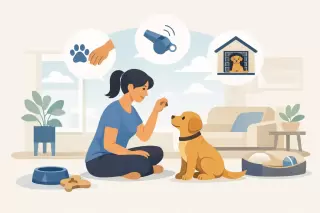
The problem usually does not start on a training field. It starts at your front door, on your sidewalk, or in your kitchen when your dog grabs food off the counter and looks proud of it. That is why working with a Whitby dog trainer in your home can make such a difference. Training is not just about getting a dog to sit on cue. It is about changing the moments that make daily life stressful.
For many owners, the frustration is not a lack of effort. They have watched videos, tried treats, repeated commands, and bought the leash that promised to fix pulling. But the dog still jumps on guests, tunes out in the yard, or drags them down the street. What is missing is often not motivation. It is a plan that fits the dog, the household, and the real situations where the behavior happens.
Why a Whitby dog trainer at home works differently
A dog can look very different in a group class than in a living room full of familiar smells, routines, and distractions. Some dogs shut down in busy environments. Others get overstimulated and practice all the wrong habits around other dogs. Puppies can be distracted. Small dogs can feel intimidated. Reactive dogs can go over threshold before learning even begins.
In-home training changes that starting point. Instead of asking your dog to behave in an artificial setting first, the lesson happens where the problems already exist. If your dog charges the door when visitors arrive, that can be worked on at the actual door. If your dog ignores you in the backyard, recall can be practiced in the backyard. If leash pulling starts the second you leave the driveway, that is where the trainer can watch it happen and coach you through it.
This matters because dogs do not automatically transfer a skill from one place to another. A dog who can sit beautifully in a quiet class may still forget everything when a delivery driver knocks or a squirrel runs across the lawn. Real progress comes from teaching the dog and the owner how to handle real life.
The behavior issues owners ask about most
Most people do not call a trainer because they want a perfect competition dog. They call because everyday routines have become exhausting. The most common issues are also the ones that affect family life the most.
Jumping is a good example. It seems simple until it happens every time guests come over, the kids walk in from school, or someone is carrying groceries. The dog is often not being defiant. The dog has learned that excitement and access go together. Training focuses on replacing that pattern with a calmer, more controlled behavior the dog can actually repeat.
Leash pulling is another major complaint, and it is rarely solved by equipment alone. Some dogs pull from excitement. Some pull because they have learned that tension gets them where they want to go. Others are distracted, anxious, or inconsistent because the rules change from one walk to the next. A trainer can see those details quickly and build a walking routine that makes sense for both dog and owner.
Recall can also be more complicated than it looks. If your dog comes when called in the house but not outside, that does not mean the dog is stubborn. It usually means the distractions outdoors are stronger than the training history. A good recall is built in layers, with timing, repetition, and rewards that match the difficulty of the environment.
Then there are the habits owners tend to laugh off at first and resent later – food stealing, barking for attention, rushing through doors, not settling when company is over, or ignoring known commands unless a treat is visible. These are not random quirks. They are patterns, and patterns can be changed with the right guidance.
Personalized training matters more than people expect
No two dogs learn the same way, even when the behavior problem looks identical on the surface. One dog pulls because he is young and overstimulated. Another pulls because she is nervous and trying to create distance. One puppy jumps because he is social and impulsive. Another dog jumps because that behavior has been rewarded for months by attention.
That is why personalized coaching matters. The trainer is not just watching the dog. They are watching the relationship between the dog and the people in the home. Timing, tone, consistency, expectations, household routines, and even room setup can all affect behavior.
A family with small children may need a different plan than a retired couple with one calm older dog. A first-time owner may need more hands-on coaching and simpler training steps. A busy household may need practical routines that can be repeated in short sessions, not a long list of homework nobody will realistically do.
When training is built around your actual life, it tends to stick. That is because the plan is not asking you to become a different kind of dog owner overnight. It is helping you communicate more clearly in the routines you already have.
What to expect from in-home dog training
A good in-home session should feel clear, not overwhelming. You should come away understanding what your dog is doing, why it is happening, and what to do next. The goal is not to impress you with complicated terminology. The goal is to make daily life easier.
That often starts with observation. The trainer may ask you to show what happens when you walk to the door, prepare food, pick up the leash, or call your dog from another room. Those moments reveal far more than a quick description over the phone.
From there, the work becomes practical. You might learn how to interrupt a behavior before it escalates, how to reward the right choice at the right time, or how to set up the environment so your dog succeeds more often. You may also be coached on what not to do. Sometimes progress comes as much from removing mixed signals as it does from teaching new commands.
This is also where one-on-one training stands apart from general advice. A technique that works beautifully for one dog can backfire with another. The point is not to force every dog into the same method. The point is to create a training approach the dog can understand and the owner can consistently follow.
Group classes are not wrong, but they are not always the best fit
Group classes can be useful in some situations. They can offer structure, social exposure, and a lower price point. For dogs who are already fairly comfortable around other dogs and people, they may be a good starting place.
But there are trade-offs. You get less individual attention. The pace has to work for the whole group. The trainer cannot fully address what happens in your hallway, on your couch, or at your own front window. If your dog is shy, reactive, easily distracted, or overwhelmed, a shared environment can slow progress rather than support it.
For owners dealing with household-specific issues, private in-home training is often more efficient. It saves time, avoids unnecessary stress, and keeps the lesson focused on the behaviors that matter most in your day-to-day routine.
Choosing the right Whitby dog trainer
If you are looking for a Whitby dog trainer, look beyond promises of quick fixes. The better question is whether the trainer can explain behavior clearly, adapt to your dog, and coach you in a way that feels doable.
Experience matters, but so does communication. You want someone who can read your dog well and also teach you without making you feel judged. Owners are often embarrassed when they reach out for help. A good trainer understands that frustration, meets it with reassurance, and turns it into a workable plan.
It also helps to choose someone who focuses on practical outcomes. Better leash manners. More reliable recall. Calmer greetings. Less chaos around meals, guests, and walks. Those changes may sound ordinary, but they are the ones that make living with your dog feel enjoyable again.
That is the value of a service like K9 Manners. The training is built around the home, the family, and the dog in front of you rather than a one-size-fits-all class format.
A well-trained dog is not a dog who performs on command for a few minutes. It is a dog who understands how to live peacefully in your home and your routine. When training starts there, the results tend to feel less like a lesson and more like relief.